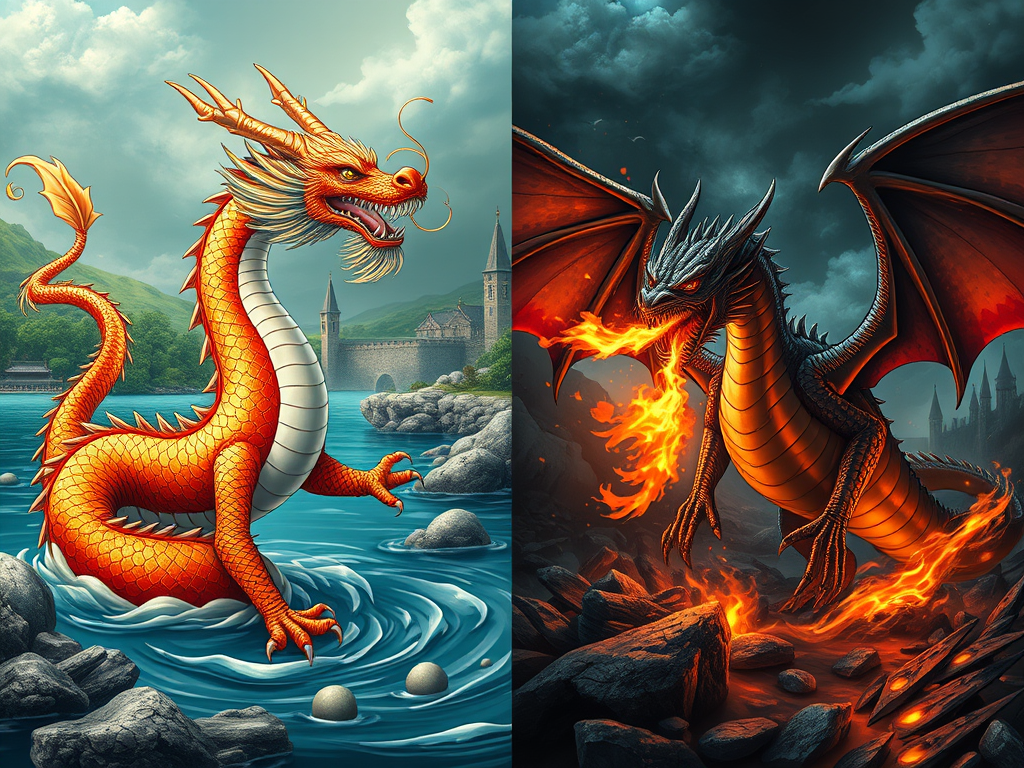
Chinese dragons are central figures in Chinese mythology, revered for their wisdom, power, and benevolence. Unlike the fire-breathing terrors of Western lore, Chinese dragons are seen as protectors and benefactors, deeply intertwined with the natural elements.
Here, we explore three of the most renowned myths about Chinese dragons, each highlighting their unique characteristics and cultural significance.
Content Table:
- 1. The Legend of the Four Dragon Kings
- 2. The Tale of Fucanglong, the Treasure Dragon
- 3. The Legend of Yinglong, the Responding Dragon
1. The Legend of the Four Dragon Kings
Overview: The Four Dragon Kings are powerful deities who rule over the seas and control the rain, crucial for agricultural prosperity. Each Dragon King governs one of the four seas surrounding China: the East Sea, the South Sea, the West Sea, and the North Sea.
The Story: In ancient times, a severe drought afflicted the land, causing rivers to dry up and crops to wither. The people prayed fervently for rain, but none came. Moved by the suffering of the people, the Four Dragon Kings—Ao Guang (East Sea), Ao Qin (South Sea), Ao Run (West Sea), and Ao Shun (North Sea)—decided to intervene.
They approached the Jade Emperor, the supreme ruler of heaven, and pleaded for rain. The Jade Emperor, preoccupied with other matters, dismissed their request. Seeing no other option, the dragons filled their mouths with sea water and flew over the land, releasing it as rain, thereby ending the drought.
Angered by their audacity, the Jade Emperor punished the dragons by imprisoning them under four great mountains. Despite their imprisonment, the dragons continued to ensure that their seas provided water to the land through underground rivers and springs.
Significance: This legend emphasizes the dragons’ role as benevolent guardians of the natural world. It highlights their compassion, bravery, and their crucial role in maintaining ecological balance.
2. The Tale of Fucanglong, the Treasure Dragon
Overview: Fucanglong, also known as the Dragon of Hidden Treasures, is a mythical dragon that guards precious gems, metals, and underground treasures. This dragon is also associated with volcanoes, believed to live beneath the earth’s surface.
The Story: According to legend, Fucanglong resides deep within the earth, guarding vast riches including gold, silver, and precious stones. Occasionally, when Fucanglong shifts or moves, it causes volcanic eruptions, sending treasures to the surface and leaving a trail of molten lava.
One famous story tells of a mortal who discovered a pathway to Fucanglong’s lair. Driven by greed, the man attempted to steal some of the dragon’s treasures. However, Fucanglong awakened and chased the thief to the surface. As the dragon emerged from the earth, the ground split open, and a volcano erupted, consuming the thief and his ill-gotten gains.
Significance: Fucanglong’s myth underscores the belief that dragons are guardians of the earth’s hidden wealth. It also serves as a moral tale about the dangers of greed and the consequences of disturbing natural harmony.
3. The Legend of Yinglong, the Responding Dragon
Overview: Yinglong, known as the Responding Dragon, is one of the oldest and most powerful dragons in Chinese mythology. Often depicted with wings, Yinglong is a divine servant who assists deities and emperors.
The Story: Yinglong is revered for its role in aiding Yu the Great, the legendary founder of the Xia Dynasty, in controlling the Great Flood. The floodwaters threatened to destroy the world, and despite numerous efforts, Yu could not control the deluge.
Yinglong responded to Yu’s plight by using its powerful wings to carve channels and riverbeds, allowing the floodwaters to flow into the sea. This monumental task helped Yu tame the flood and save humanity. Yinglong’s intervention was pivotal in establishing the foundations of ancient Chinese civilization.
Another tale involves the Yellow Emperor, Huangdi, who fought a fierce battle against the tyrant Chiyou. Yinglong aided the Yellow Emperor by summoning rains and floods to weaken Chiyou’s forces, ensuring Huangdi’s victory and uniting the Chinese tribes under his rule.
Significance: Yinglong represents divine intervention and the importance of dragons in Chinese mythology as protectors and saviors of humanity. The myth highlights themes of loyalty, service, and the harmonious relationship between nature and mankind.



 Culture to Know