Are you familiar with palm reading? Palmistry, also known as palm reading or chiromancy, is considered one of the revered divination practices but can be challenging to comprehend. This mystical art entails analyzing physical hand features to predict future happenings and interpret personality traits. In palm reading, hands are considered windows through which invaluable insights are acquired. However, grasping palm reading basics, such as the life line and love line, is simpler than commonly presumed.
This guide delves into the fundamental theories and techniques of palm reading while providing tips to help you develop your unique approach.
Which Hand Should You Read?
According to ancient Chinese palm-reading theory, females are represented by the right palm while males are represented by the left. However, mainstream palm reading recommends that both hands should be read as it is a more credible theory. Additionally, the dominant hand is believed to reveal the present and future, including opportunities, challenges, and limitations, while the non-dominant hand is thought to disclose inherent characteristics such as personality, innate abilities, and potential.
Understanding your unique characteristics through palm reading could provide you with more inspiration, direction, and ambition to shape your destiny.
What Are the Types of Hands?
It is essential to take your time and silently observe the querent’s hand cupped in your own. Pay attention to the texture; is the front smooth while the palm is rough? Are the fingers clean or dirty?
There are four primary hand shapes in palmistry: the earth hand, air hand, water hand, and fire hand. Determine which hand shape you possess by reading on below to discover how to identify them. Each hand shape corresponds to varying aspects of life such as career, personality, and more.

(Image Source: https://www.chinahighlights.com/palm-reading/)
Earth Hands
Individuals with earth hands have a palm that is square, thick, and tough to touch, and short fingers that are equal in length to the palm. Often, their skin is ruddy in color. Those with earth hands tend to be pragmatic, reliable, energetic, and responsible. They excel at carrying out tasks and can be valuable assets to any leader.
People with earth hands are generally content with a stable plan or situation and are not particularly ambitious or desirous of elaborate experiences or possessions. They are well-suited for jobs that require basic skills without intricate operations. These individuals rarely engage in romantic gestures and favor a simple lifestyle that meets their practical needs. However, they may become overly focused on immediate concerns, leading to a lack of long-term planning and achievement.
Fire Hands
A fire hand can be identified by its square or rectangular palm, short fingers, and ruddy or pink hue. Those with fire hands are typically energetic, smart, diligent, outgoing, optimistic, and self-assured, although they may lack empathy and sensitivity. They thrive on adventure and vibrant, exciting experiences, making them avid travelers who are always on the go. Driven by their passions, they tend to approach life boldly and intuitively, sometimes without much forethought.
The palm of a fire hand is longer than the fingers, and the hands often exhibit pronounced creases and prominent mounds. People with fire hands are recognized for their passionate nature, self-assurance, and hardworking attitude, even on the toughest day. However, their tendency to overlook the feelings of others may lead to less than satisfactory results in social situations.
Air Hands
Individuals with air hands possess square or rectangular, dry palms with long fingers that typically have big knuckle bones. Their fingers may be spindly, with protruding knuckles, and boney. Air hands are often intelligent, adaptable to change, and skilled at analyzing information. They have a deep sense of curiosity and imagination which fuels their creative abilities. Sharply attuned to the nuances of social interaction, air hand people are flexible in mind and romantic in lifestyle, though they may sometimes feel unsettled or restless in the absence of intellectual stimulation.
Water Hands
One can identify water hands by their long or oval-shaped, soft, and clammy palms, long and conical fingers, and overall narrow appearance. Those with water hands are intuitive, empathetic, imaginative, and introverted, often possessing a strong, creative streak. They are also quite sensitive, and their emotions are frequently readily affected. While fragile, they’re quite flexible, seamlessly adapting to changing situations. These individuals are also deeply moved by beauty and art and will be drawn to it at most times, thanks to their introspective nature.
What Do Lines on Your Palm Mean?
Palm reading enthusiasts often use the folds and creases in one’s hands, commonly known as lines, to interpret and predict future events. The meanings of these lines are determined by analyzing their length, depth, and curvature. Although no two palms are alike, interpreting the context of where each line begins and ends, which mounts it crosses, and where the creases intersect is crucial.
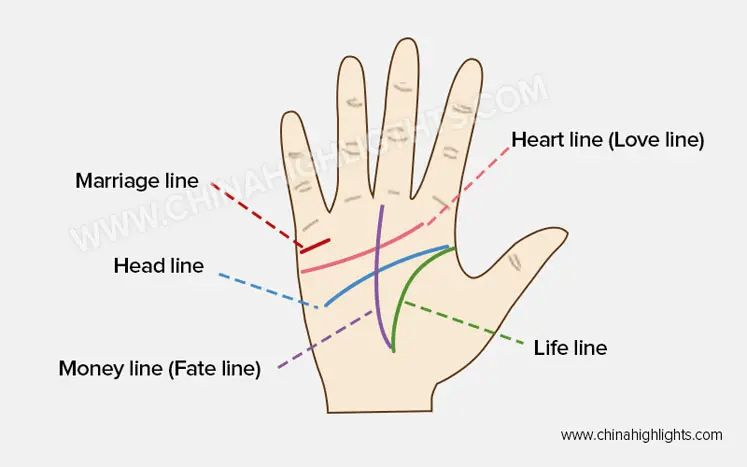
(Image Source: https://www.chinahighlights.com/palm-reading/)
The Head Line
The head line is the crease that runs across the center of one’s palm, reflecting a person’s intelligence and mentality. Its clearness, length, and thinness reveal an individual’s mental focus and cleverness. A significant curve in the head line is an indication of creativity, while a short line implies a higher probability of physical accomplishments over mental ones.
However, when a circle intersects the head line, the line is divided into two, or the line wavers, it may suggest poor memory and distractibility. Sustaining focus for an extended period can be challenging.
Regarding intellectual interests, the head line is a significant indicator of the lessons individuals must learn throughout their lives. The depth of the line corresponds to the complexity of one’s mental pursuits, while its length reveals the range of topics explored. The straightness of the line represents a traditional approach, whereas a wavy line indicates progressive thinking. Breaks in the line may signify mental struggles or critical breakthroughs and epiphanies.
The Heart Line
The heart line, also known as the love line, is an important horizontal line on the palm that represents matters related to the heart, including emotions, reactions, and control. Its position and length are crucial in determining an individual’s attitude towards love, friendship, sexuality, and commitment.
A longer and straighter heart line is a positive indication, while a short and straight heart line suggests little interest in love or romance. The beginning of the heart line plays a crucial factor in predicting the individual’s love experience – commencing from the index finger predicts a happy love life, while starting from the middle finger implies the person is usually self-centered.
The line’s rise and fall indicates the probability of falling in love with multiple partners; each relationship may last a short while. Circles on the heart line, division into sections, or thin lines crossing it usually signal dissatisfaction with an individual’s love life.
The Life Line
The life line, which curves around the thumb, reveals an individual’s energy and well-being, rather than the length of their life. A clear and arced life line indicates robust health and vigor, and longer life lines suggest talent in sports. In contrast, a small, close-to-the-thumb arc indicates frequent fatigue and exhaustion.
Multiple life lines on the palm indicate a lively and dynamic personality. If the life line begins with a break near the thumb web, it suggests a sickly childhood, and if it ends raggedly near the wrist, it warns of potential health problems in old age.
A circle or cut on the line indicates potential physical injury or illness, while the size of the circle corresponds to the severity of the health issue. If the life line runs straight across the palm, equidistant from the head line, it suggests an outgoing, brave personality. Despite common beliefs, a short or severed life line does not imply a shorter lifespan but rather a life of independence and autonomy.
The Money Line
The money line, located in the center of an individual’s palm, is a vertical crease that reveals the degree to which external circumstances will influence their life. Changes in this line may indicate significant shifts in an individual’s life. Many people believe that itchy palms signal upcoming changes.
On the other hand, the money line, sometimes called the fate line as well, is the line that stretches from the wrist to the middle finger, reflecting an individual’s career and fortune.
Palm readers analyze the money line’s characteristics to determine an individual’s financial future. If the money line and life line have the same starting point, it signifies that the person is ambitious and has strong self-confidence. Two money lines suggest that the person may have two jobs simultaneously or a side business. A clear and straight money line is considered lucky and signifies a stable future with no need for significant changes or effort.
If the money line is divided into two or more sections, it indicates that an individual is prone to frequent job changes or their life/career could undergo significant changes. A short money line suggests that an individual may retire early or stop working at an earlier age.
The Marriage Line
The short line above the love line and immediately under the little finger is known as the marriage line, reflecting an individual’s romantic relationships and marriage.
While some people may have various lines in this location, the number of lines does not bear any significance. It is essential to read the clearest line. If there are two equally clear marriage lines, one must be cautious of a potential love triangle.
If there are numerous marriage lines with no primary line, an individual’s marital life may not be enjoyable. A short and shallow line that veers upward typically indicates a delayed or nonexistent marriage. If the marriage line extends to the area between the little finger and ring finger, it suggests that an individual is highly selective when choosing a partner.
If the line stretches to the ring finger, it is believed that their spouse’s family is wealthy and welcoming. However, if it extends further beyond the third finger, it is not considered auspicious, and their reputation and wealth may be affected by the marriage. If there is an island-like circle on the marriage line, it may signify periods of physical separation between the couple.
If the marriage line splits into two under the little finger, an individual must pay careful attention to managing their relationship as there may be a chance of separation.



 Culture to Know